The Factory Floor Has Changed
Production schedules shift weekly. Product mixes grow more complex every quarter. And the workforce that once kept operations running smoothly is becoming increasingly difficult to find, train, and retain.
For years, manufacturers turned to fixed automation to improve productivity. While effective for repetitive and predictable tasks, traditional robotic systems come with a significant limitation: they stay where they're installed.
A robotic arm bolted to a single workstation can't respond to changing production needs, move between processes, or support multiple operations across a facility.
That's exactly the challenge mobile manipulation was designed to solve.
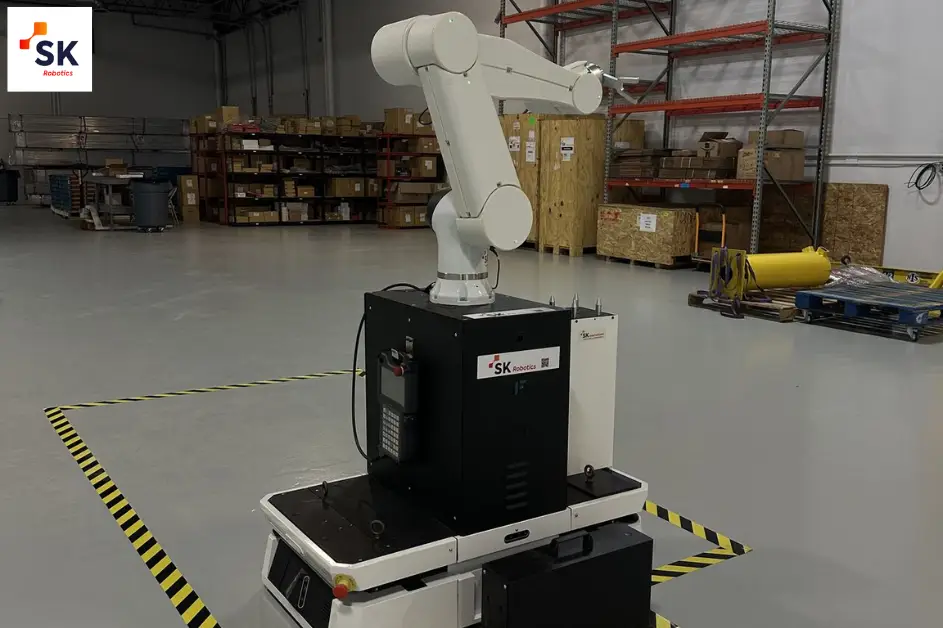
By combining the autonomous mobility of an Autonomous Mobile Robot (AMR) with the precision and dexterity of a robotic arm, mobile manipulation creates a new class of intelligent automation. These systems can navigate dynamic environments, interact with machines, transport materials, perform tasks, and adapt to changing workflows all within a single integrated solution.
This isn't a future concept reserved for cutting-edge facilities.
Manufacturers are deploying it today, and those who get the integration right are pulling ahead.
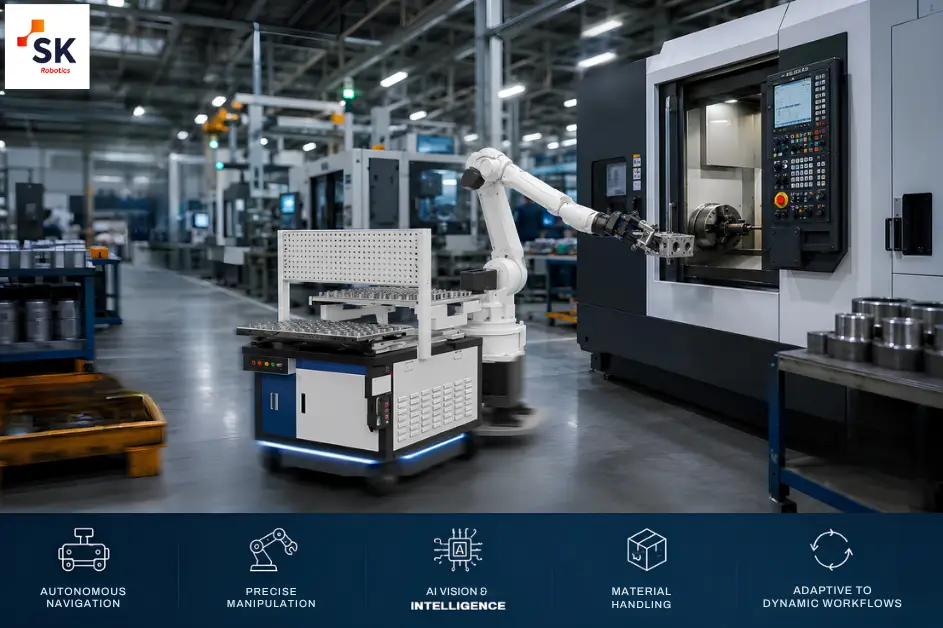
Mobile manipulation combines two powerful automation technologies:
AMRs are self-navigating robotic platforms capable of moving throughout a facility without fixed paths, magnetic tape, or extensive infrastructure modifications. Using advanced sensors, LiDAR, cameras, and intelligent software, AMRs safely navigate around people, equipment, and changing environments.
Robotic arms are designed to perform physical tasks with speed, consistency, and precision. They can pick, place, assemble, inspect, load machines, and handle materials with a level of repeatability that exceeds manual operations.
When combined, these technologies create a mobile manipulator an intelligent system capable of traveling to where work is needed and performing tasks upon arrival.
Instead of bringing work to a robot, the robot brings automation directly to the work.
Mobile manipulation is far more advanced than simply mounting a robotic arm onto a mobile base.
Modern systems integrate multiple layers of intelligence, including:
These capabilities allow the system to function as an active participant in manufacturing operations rather than a standalone machine.
Manufacturing is undergoing a significant transformation.
Today's facilities face:
As a result, manufacturers need automation that is flexible, scalable, and capable of adapting to change.
Mobile manipulation delivers exactly that.
Traditional automation has delivered tremendous value for decades. However, it was designed for environments where processes rarely changed.
In many facilities, fixed robots are still limited by a simple reality:
One robot serves one workstation.
This creates several challenges:
While effective in dedicated applications, fixed systems often struggle to support modern manufacturing demands.
Manufacturers today face challenges that extend beyond simple productivity improvements.
Key pressures include:
Finding and retaining skilled workers remains one of the industry's biggest concerns.
Manufacturers increasingly produce a wider variety of products in smaller quantities.
Production requirements change faster than ever before.
Labor, energy, and material costs continue to increase.
Customers expect faster delivery, higher quality, and greater customization.
Meeting these demands requires a more adaptable approach to automation.
The true cost of rigid automation often appears in unexpected places:
Over time, these inefficiencies can significantly impact throughput and profitability.
Mobile manipulators combine mobility and task execution into a single platform.
Instead of relying on separate systems for transportation and machine interaction, manufacturers gain automation that can:
Automation follows the work rather than remaining fixed in one location.
A typical mobile manipulation workflow includes:
The AMR safely navigates to a designated location.
Integrated vision systems identify equipment, parts, and environmental conditions.
The robotic arm performs tasks such as picking, placing, loading, unloading, or inspection.
The system moves to its next assignment, maximizing utilization across multiple operations.
This enables continuous productivity across a broader section of the facility.
Hardware alone does not create intelligent automation.
The real value comes from software integration.
Modern mobile manipulation solutions often include:
Together, these technologies create a connected automation ecosystem that improves visibility, coordination, and operational efficiency.
Mobile manipulators can adapt to changing production requirements without extensive reconfiguration.
One system can support multiple machines, workstations, and processes throughout the day
Routine transportation and machine tending tasks can be automated, allowing employees to focus on higher-value activities.
Organizations often gain greater utilization from a mobile system than from multiple fixed installations.
Mobile manipulation reduces repetitive lifting, pushing, carrying, and machine-loading activities.
Many facilities can deploy mobile manipulation with minimal infrastructure changes.
Mobile manipulators can load and unload CNC machines, lathes, presses, and other production equipment.
Parts, raw materials, and finished goods can be moved autonomously throughout the facility.
Systems can deliver components directly to assembly stations and perform repetitive assembly tasks.
Integrated vision systems enable automated inspections and production monitoring.
Mobile manipulators support inventory movement, replenishment, and order fulfillment processes.
A single platform can support several manufacturing processes during a shift, improving overall asset utilization.
Many automation projects focus heavily on hardware selection.
However, hardware is only one piece of the puzzle.
Successful deployment depends on:
Without integration, even the most advanced technology can fail to deliver expected results.
At SK Robotics, we approach mobile manipulation as a complete operational solution rather than a standalone product.
Our expertise includes:
The result is a cohesive automation environment designed around real production requirements.
Successful automation isn't about forcing operations to fit a robot.
It's about designing automation that fits the operation.
Every manufacturing environment is unique.
That's why effective mobile manipulation solutions begin with understanding workflows, identifying bottlenecks, and aligning technology with business objectives.
We focus on connecting technologies into complete operational systems.
We identify the best-fit technologies based on application requirements rather than limiting customers to a single platform.
From concept development through deployment and support, our team manages the complete automation journey.
We integrate software, controls, robotics, and data systems into a unified automation environment.
Solutions are designed not only for today's needs but also for future expansion and operational evolution.
Your operation may be an ideal candidate if you are experiencing:
If these challenges sound familiar, mobile manipulation may offer a path toward higher productivity and greater operational resilience.
Artificial intelligence is enabling robots to make smarter decisions and adapt to changing environments.
Connected fleets of robots will coordinate tasks across entire facilities.
Mobile manipulators will become key components of fully connected manufacturing ecosystems.
Future production environments will require automation capable of responding dynamically to changing demands.
Mobile manipulation serves as the bridge between today's automation requirements and tomorrow's intelligent factory.
The next generation of manufacturing automation won't be defined by robots that stay in one place.
It will be defined by intelligent systems that move where they're needed, perform meaningful work, and adapt as operations evolve.
Mobile manipulation brings together the best of autonomous mobility and robotic precision, helping manufacturers unlock greater flexibility, efficiency, and scalability.
At SK Robotics, we help manufacturers move beyond standalone technologies by designing fully integrated automation solutions aligned with real operational goals.
Whether you're exploring machine tending, material handling, intralogistics, or broader factory automation initiatives, our team can help identify the right strategy for your operation.
Connect with SK Robotics to discover how mobile manipulation can improve productivity, reduce labor challenges, and create a more flexible manufacturing environment. https://skrobotics.us/contact-us.php
Mobile manipulation combines an Autonomous Mobile Robot (AMR) with a robotic arm, enabling a single system to move throughout a facility and perform physical tasks such as machine tending, material handling, and assembly support.
The AMR provides autonomous mobility while the robotic arm performs task execution. Together, they create a flexible automation platform capable of traveling to different locations and performing work where needed.
Benefits include increased flexibility, reduced labor dependence, higher equipment utilization, improved safety, faster ROI, and scalable automation.
Industries include automotive, aerospace, electronics, consumer goods, logistics, warehousing, food processing, and general manufacturing.
Mobile manipulators can autonomously move between machines, load and unload parts, and maximize equipment uptime without requiring dedicated robots at every workstation.
Yes. Modern mobile manipulation platforms can integrate with ERP, MES, WMS, fleet management software, and production control systems.
SK Robotics focuses on complete system integration, combining robotics, AMRs, software, vision systems, and operational workflows into scalable solutions designed around customer processes and long-term business goals.
OUR EXPERT TEAMS WILL REACH
OUT TO YOU IN NO TIME