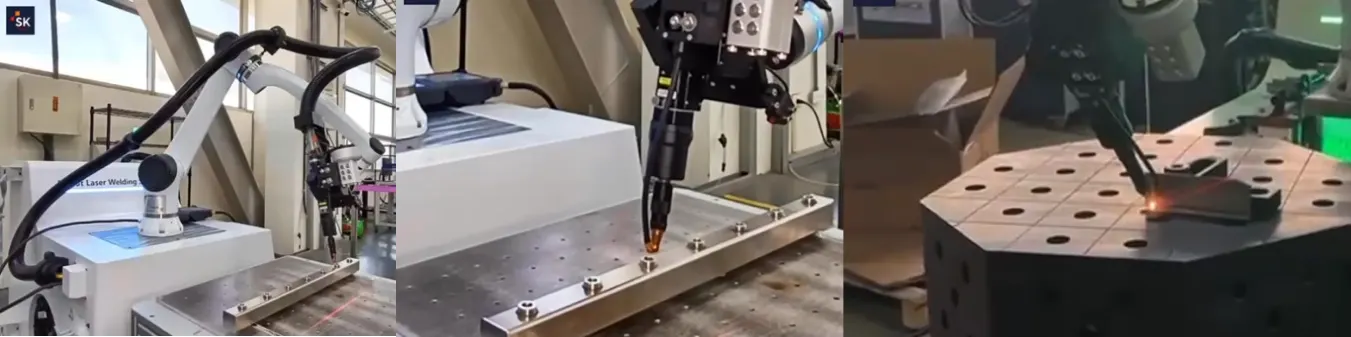
High-mix, low-volume manufacturing has always been the hardest environment to automate. Part runs
are short, parts change constantly, and traditional welding cells weren't built for it. The SK Robotics
Cobot Laser Weld Cell was.
What Makes This Cell Different
Most cobot welding solutions on the market today ask manufacturers to accept a tradeoff: get the
flexibility of a collaborative robot, but still spend significant time manually teaching weld paths for every
new part. In a job shop or contract manufacturing environment running 50 to 500-part batches, that
overhead quietly destroys ROI.
Vision-guided automation changes that equation entirely. This cell doesn't ask the operator to be
precise - it handles precision itself. There are two capabilities that separate it from what most of the
market offers today. Neither is a software add-on or third-party accessory bolted on after the fact.
One-button vision positioning:Drag the cobot to an approximate position, press one button, and
vision locks onto the exact weld target automatically. No manual fine-tuning by hand and eye.
Real-time seam tracking, no bulk added:Part variation up to 5mm is compensated in real time.
No high-precision fixturing needed. No line scanner bolted to the weld head - seam tracking is
native to the system.
How the Market Stacks Up
On positioning: most competitors using red-laser-beam guidance still require the operator to position
the arm accurately by hand and eye. One button versus ongoing manual effort - that gap compounds
across every job changeover.
On seam tracking: the common approach is to attach a line scanner to the cobot weld head. It works,
but it adds bulk, limits access in tight geometries, and introduces a third-party integration that costs
time and money to maintain. This cell has seam tracking built in - nothing added, nothing to integrate.
Who This Is Built For
This cell was designed with HMLV environments front of mind. The right fit includes:
Contract manufacturers running high variety, short-run parts
Automotive Tier 2 and Tier 3 suppliers managing frequent changeovers
EV and battery assemblers needing consistent, repeatable welds
Aerospace fabricators working with tight tolerances on varied geometry
Any facility where the part mix changes faster than traditional automation can keep up
If your floor sees the same part for weeks at a time, fixed automation is probably fine. But if you're
running dozens of part numbers in a single shift, you need a system that reconfigures in minutes, not
hours.
Part of Something Larger
The cobot laser weld cell is a strong standalone product. But it gets more interesting when you zoom out
and look at what it fits into.
At SK Robotics, the direction has always been toward a full automation ecosystem, not a collection of
disconnected hardware. AMRs that navigate autonomously. Cobots that manipulate parts at
workstations. Software that orchestrates all of it. And now, a welding cell that brings vision-guided
precision into the mix.
Pair the weld cell with mobile manipulation, an AMR carrying a cobot arm across the production floor,
and you start to see what true flexible manufacturing looks like at scale. The robot doesn't just work at a
station. It moves with the floor.
We're building toward a showroom where you can see all of this in action, in one space. The cobot laser
weld cell is the latest addition to a lineup that's growing with intention.
A Note on the Syntec Partnership
This cell is brought to North America in partnership with Syntec, a robotics and automation
manufacturer with deep experience in precision motion control. The robot arms in the cell, part of the
same lineup now available on the SK Robotics product page, are engineered for the repeatability that
laser welding demands.
SK Robotics serves as the North American integration and distribution partner, handling application
engineering, deployment, and ongoing support. The hardware is Syntec. The solution, and everything
around it, is SK.
Interested in what the cobot laser weld cell could do for your operation? Let's talk.